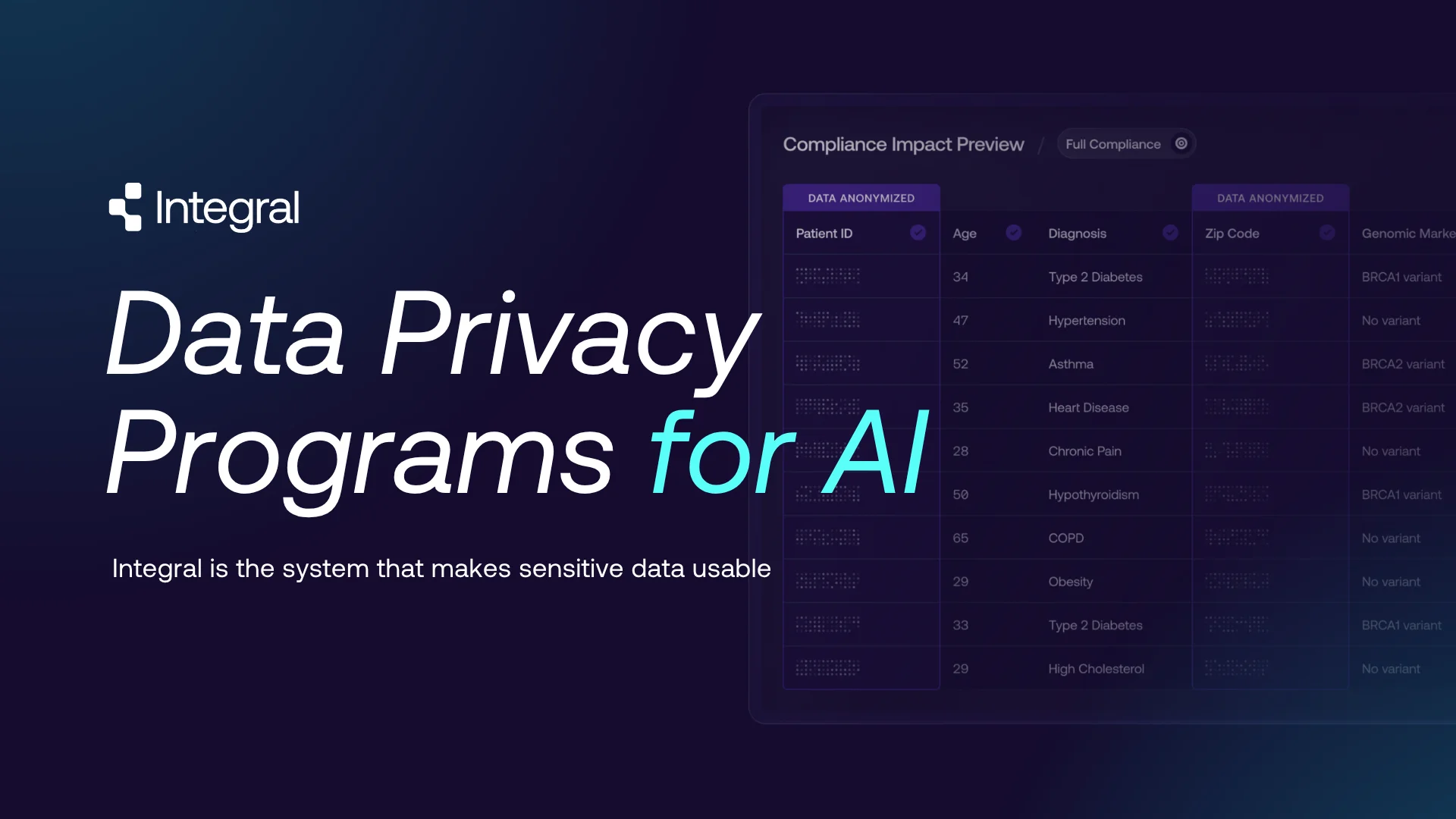
De-identify and document enterprise data at scale.
Integral Privacy Sanitization assesses, de-identifies, and documents sensitive data at enterprise volume while preserving the signal that makes it valuable. Every output ships with end-to-end evidence: assessment, remediation detail, utility metrics, and methodology provenance.
Enterprise scale, defensibility standard
De-identification at enterprise scale is its own discipline. Individual dataset assessments do not account for the volume, variety, and velocity of data flowing through enterprise pipelines. Integral Privacy Sanitization is purpose-built for this problem.
The platform processes data at volume while applying the same statistical risk assessment methodology used in individual dataset engagements. Every output is assessed, documented, and signed off at the dataset level.
Why this is its own discipline
Enterprise data pipelines move millions of records across dozens of tables and schemas. The interaction effects between fields, tables, and datasets create re-identification surfaces that single-table assessment misses. Integral Privacy Sanitization evaluates risk at the dataset level and the pipeline level.
How Integral Privacy Sanitization works
Map the enterprise data landscape
Integral maps tables, schemas, field relationships, and downstream uses to define the full assessment scope.
Assess at scale
Statistical risk assessment runs across the full dataset landscape. Cross-table and cross-schema interaction effects are evaluated.
Signal-preserving de-identification
Remediation is calibrated per-field and per-table to preserve analytical and training value. Utility is measured and documented at every level.
Document and deliver
Every output ships with end-to-end evidence: assessment scope, remediation detail, utility metrics, and methodology provenance. Re-assessment keeps the posture current as pipelines evolve.
What makes it different
Signal-preserving at scale
Remediation is calibrated to preserve utility at the field, table, and dataset level. Blunt anonymization is replaced with targeted, documented engineering.
Assessed and documented
Every dataset ships with end-to-end documentation: what was assessed, how it was remediated, and what utility was preserved. The evidence package satisfies procurement and regulatory review.
Runs where your data lives
Integral Privacy Sanitization deploys wherever your data already is — including directly in Databricks. See Deployment Options for details.
Trusted by teams building on sensitive data

“Integral provided the expertise and structure we needed to turn complex, regulated healthcare data into actionable insights. Their team is consistently responsive, highly knowledgeable, and deeply collaborative. They bring a level of rigor, attention to detail, and flexibility that is critical in this space.”

“Integral goes beyond the initial report. They peel back the layers and keep asking the right questions until they truly understand how your data works. That level of attention is what you need when pharma clients are asking hard questions and expect real answers.”

“We wanted a solution that would allow us to massage the data sets we were already using and augment them over time - without requiring a from-scratch re-analysis of the overarching data set. Today, all our data sources go through Integral before they ever hit an environment we access. Without Integral's flexibility, we couldn't stay defensible as data shifts.”
Frequently asked questions
How does this differ from standard de-identification tools?
Standard tools apply generic rules across datasets. Integral Privacy Sanitization assesses re-identification risk statistically, calibrates remediation per-field, and produces a signed opinion with methodology provenance. The output is assessed data, not just transformed data.
What types of enterprise data does this handle?
Any structured or semi-structured sensitive data: EHR, claims, financial, consumer, operational. The platform handles multi-table schemas with cross-table field relationships.
Does data leave our environment?
That depends on the deployment model. Multiple options keep all data in your infrastructure. See Deployment Options for details.
How is data utility measured?
Utility metrics are computed before and after de-identification at the field, table, and dataset level. The tradeoff between privacy and utility is explicit and documented.